Tuesday, January 14, 2014

Day 5, Part 1: Jerusalem, Mount of Olives

This morning is a bit more relaxed for our group.  Instead of being out the door before 8, we're leaving at 9, so I have a little time to blog.  Sunday, our first day in Jerusalem, was a big one, so I'm dividing it into two posts.  I hope I can get both done today, but we'll see.

After leaving the hotel, we started our morning at the same place we ended the previous evening, overlooking the Old City of Jerusalem from the Mount of Olives.  This is the direction Jesus and his disciples would have come into the city from during the triumphal entry (Palm Sunday).  Our tour for the morning would follow the path down the Mount of Olives they would have walked:


A wider view with the Kidron Valley between us and the eastern wall of the city.  The large gold dome is the Dome of the Rock, a Muslim shrine built on the site of the Second Temple.  In the foreground is the largest Jewish cemetery in the world.


Our group taking in the view:


Before we began our walk, Gila had arranged a professional photographer to be there to take a group picture for us.  A camel was also there that you could ride and several took advantage of the opportunity, including Betsey:


After that, we started our walk down the Mount of Olives.  The first place we stopped was to see some caves with some bone boxes or ossuaries inside, some of them dating to the 1st century AD:


The next place we stopped is the traditional site of where Jesus lamented over Jerusalem and expressed his desire to gather the people like a hen gathers chicks.  Here's Pastor Art reading that passage from Matthew 23 for us:


There's a church built on the site called Dominus Flevit (Jesus Wept), as well as restrooms, so we took a few minutes to explore the place.  It's another good spot to get a nice view of the city.  Here I am with the Dome of the Rock in the distance.  Beyond that you can also see the gray dome of the Church of the Holy Sepulchre and the tower of the Lutheran Church of the Redeemer:


The view from inside the Dominus Flevit church:


A nice mosaic on the front of the altar portraying the text from Matthew:


The outside of the church, shaped like a teardrop:


Onward from there, we continued to descend down the Mount of Olives toward the Garden of Gethsemane:


A view to the south across the Jewish cemetery:


Here are some of the very old olive trees in what remains of the Garden of Gethsemane.  It was a much larger place in Jesus' day.  Olive trees can live for thousands of years, so it's possible that these trees were young when Jesus and his disciples came here.


A closer view of the base of one of the trees with new shoots coming out of it.  This is what Isaiah refers to in Isaiah 11 with the shoot that comes from the stump of Jesse:


There's a church on this site as well (get used to that) called the Church of Gethsemane.  It was one of my favorite churches we visited.  It's designed so that the inside reflects the feeling of being in the garden at dusk at the time Jesus and the disciples would have been there and there are several beautiful paintings at the front of the sanctuary depicting these scenes.


The painting behind the altar.  This is the same scene that is depicted in the stained glass window behind the altar at Trinity Lutheran in Brooten where I serve; Jesus praying in the garden:


An overall view of the sanctuary:  You can maybe see how the ceiling is decorated with stars and the windows are purple to diffuse the light and really make it feel like dusk.  Like I said, in my opinion, one of the most beautiful sanctuaries we've seen:


 After Gethsemane, we caught our bus and drove around the eastern wall of the Old City to the south side.  Along the way we passed Solomon's steps, visible in the center of the picture next to the wall.  These would have been there in Jesus' day:


Our next stop was the Upper Room where Jesus celebrated the Last Supper with his disciples.  It may not be the exact room, but it's in the general area of the city where they would have been and is the same type of room they would have used.  Along the way walking to get there, we passed the Zion Gate.  When Jordan occupied Jerusalem, this was part of the border.  On the left was Israel and a place they now call Mount Zion.  The pockmarks in the wall are from the fighting that took place here:


Another sight along the way was this statue of King David:


Inside the Upper Room, we sat and had a lengthy but wonderful conversation.  Here is the door into the room:


Our guide Gila during our great conversation.  She said it was probably the longest discussion she had ever had in that place and we all enjoyed it.  I'd love to tell you all about it, but it will have to wait for another time:


On our way back to the bus, passing the Zion Gate again, we found a large group of young Israeli soldiers gathering for a picture in front of it.  Service in the military is compulsory for young people, although they can request not to serve.  We saw many groups like this touring some of the same places we were:


From there we drove through the modern city of Jerusalem out into what's called in the Bible the hill country of Judea.  Along the way we passed this playground, so I thought I'd show you as an example that life in Israel is very modern and felt quite familiar to most of us, aside from the language and geography:


The hill country of Judea.  Terraces along the hills are for agriculture:


Our destination here was the Church of the Visitation, where Mary traveled to see Elizabeth when they were both pregnant with Jesus and John the Baptist.  The walk up to the church was probably the most strenuous of our trip:


The Church of the Visitation.  You can see "Magnificat" in the pavement in front.  


The decoration on the front of the church:


Opposite from the church was this large wall with the Magnificat written in many different languages:


For the Norwegians out there:


For those who prefer English:


Pastor Art read the story of the visitation including the Magnificat from Luke 1 for us, with the English words right behind him.  I'm sure he planned it that way:


There was a small chapel we could look into, and this was one of the paintings inside:


And a statue outside in the courtyard.  This became one of my favorite stories this last summer and fall as we had many women in our congregation who were pregnant, including my wife.  There's something very human about the story that transcends time and culture to encapsulate the joy that typically takes place when pregnant women meet.  No wonder Mary was inspired to sing such a beautiful song.


That's it for the first part of our first day in Jerusalem.  I have to head to the bus to go back into the Old City during our free day here.  Our last day in Jerusalem and then we begin the journey home!  Peace to you all.

+PBK

Monday, January 13, 2014

Day 4, Galilee to Jerusalem

It's now Monday evening here in Jerusalem.  We've had another full day of exploring, this time traveling down to the Dead Sea.  I know I say this about every day, but it really was absolutely wonderful and chock full of amazing sights and experiences I can't wait to share with you.  One thing at a time, though, as I need to first get you to Jerusalem with us.  For that we have to go back to Saturday.

Because we have quite a few farmers on our trip, they decided it would be interesting to try to tour something agricultural during our time here.  We stayed at Maagan on the Sea of Galilee because it's owned by and operated by a kibbutz that also does some farming, so on our last morning there, one of the members of the kibbutz gave us a tour of some of their agricultural operations.  This is one portion of the trip where my knowledge is admittedly limited, so I won't be able to share every detail, as you'll quickly see.  However, as I told the group later, I took great joy in seeing their joy during this experience.  It was a lot of fun to watch the sharing of information and mutual respect that was evident between farmers from opposite sides of the world.

First, we went to see the main part of the kibbutz.  This is one of the streets with a kindergarten and senior center on the left.  You can also see a raised stone area that looks like a garden on the left.  This is actually a bomb shelter for protection in the event of rocket attacks from the hills above the kibbutz like the ones that occurred in 1973 during the war with Syria.


Another part of the central area of the Maagan kibbutz.  


Then we went out to some of the fields just to the south across the highway from where we had been staying.  The sun was already fairly high into the sky on a beautiful morning.  A banana field with netting over it is on the right and some kind of fruit trees are on the left.  The nets are crucial to being able to grow bananas here.  I don't remember exactly why, but they are...something about needing less water or controlling temperature...well, clearly, we're getting out of my field of expertise, so I'll just show you the picture:


Elie was the man from the kibbutz who was giving us the tour:


Another man who is specifically in charge of banana production, whose name I've unfortunately forgotten, arrived to show us the banana fields:


He also had his dog with him, and since after only a few minutes they were deep into conversation about farming that was pretty well over my head, I befriended the dog:


The ongoing farming conversation:


Then we went into the banana field itself, where he showed us the trees:


Indeed, they were banana trees.  The plastic is to help keep them from freezing...or ripen more slowly...or...something :)


So they occasionally give agricultural tours to groups, but I'm pretty sure this was the first time he'd been asked to show the irrigation pipe and certainly the first time he had a number of people wanting to take pictures of it.  He even caught up with us again later to show them a short section of hose that he sliced open to show them some filters on the inside.  I think he gave it to them to keep.  Very very nice guy.


Of course, I tried to learn more about irrigation practices in banana fields, but my mind started to wander, so I took some pictures down the rows of trees:


A picture with some of the farmers:


Next, we drove just a bit farther down the fields to see the mandarin oranges.  This man, again, whose name I've unfortunately forgotten, told us about how they grow the trees:


He also offered to let us pick a few oranges and eat them while we talked.  It was by far the sweetest, best orange I've ever had in my life.  I usually don't like to eat oranges because of the texture, but these just melted in your mouth with a burst of juice.  Absolutely delicious:


When one wasn't enough, he let us keep picking and eating them.  I caught Betsey reaching for another:


A look down a couple of the rows of trees:


Another portrait of farmers.  I just love this picture...again, taking joy in the joy of others is a wonderful thing:


This was the view down the road we took into the fields.  Banana fields are on the right, cedar trees on the left, and the oranges are on the other side of them.


From there, we drove west to the other side of town to another kibbutz to view their dairy operation.  When Elie first boarded our bus in the morning, he said we would go see the Maagan kibbutz, then "everything else, the banana fields, the oranges, the cow sheds" except with his accent, we thought he said "cow s**t" so we all had a good laugh over that one.  Anyway, on to the cow sheds:


Pastor Art has an affinity for cows, so we enjoyed seeing him overjoyed in the presence of Israeli cows:


A few curious looks:


Elie explaining something to us about the operation:


Tractor with palm trees:


In the barn with the calves, I was having too much fun taking pictures to pay much attention:


Ok, so that was our agricultural tour.  I'm sure any of the farmers on our trip will be able to tell you many many more interesting details about this, but obviously I can't, so we're going to move on.  All I can tell you is that they were all very impressed with the farming on the kibbutz and it really was a lot of fun and a highlight of the trip, even for me.  After boarding the bus again, we were on our way west toward Mt Carmel.  This took us away from the Sea of Galilee for the last time, so I snapped a parting picture:


After a while, we arrived at Mt Carmel and our bus made its way to the top where there is (surprise!) a monastery.  There is actually a Catholic monastic order known as the Carmelites that was formed here.  We went to their monastery for our visit to the area.  Mt Carmel is most notable in the Bible as the location where Elijah confronts and slaughters 450 prophets of Baal during the time of Ahab and Jezebel.  You can read that story in 1 Kings 18.  Basically, King Ahab and the people have turned away from worshiping God to Baal.  God sends Elijah to Ahab who calls for them to repent and announces a drought over the land.  Finally, at the climax of the story, Elijah and the prophets of Baal go up Mt Carmel where they will finally settle the score.  Both the 450 prophets of Baal and Elijah try to call down fire from heaven so they can see whose god is the true God.  Elijah triumphs, the people of Israel turn back to God (at least for a while), the 450 prophets of Baal are chased down the mountain to the Wadi Kishon where Elijah kills them, and the drought ends.  This is looking down the mountain toward the Wadi Kishon:


Another view from the top:


A statue of Elijah in the courtyard of the monastery:


From the monastery we went to a nearby town for lunch.  We usually stop at a little mom and pop type sandwich stand with a selection of salads or a choice between chicken and falafel (ground chick peas rolled into balls and fried in oil) sandwiches.  I had the falafel sandwich and some veggies this time:


After lunch, we headed farther west to the Mediterranean Sea.  This is looking back east from the coastal plain to the hills:


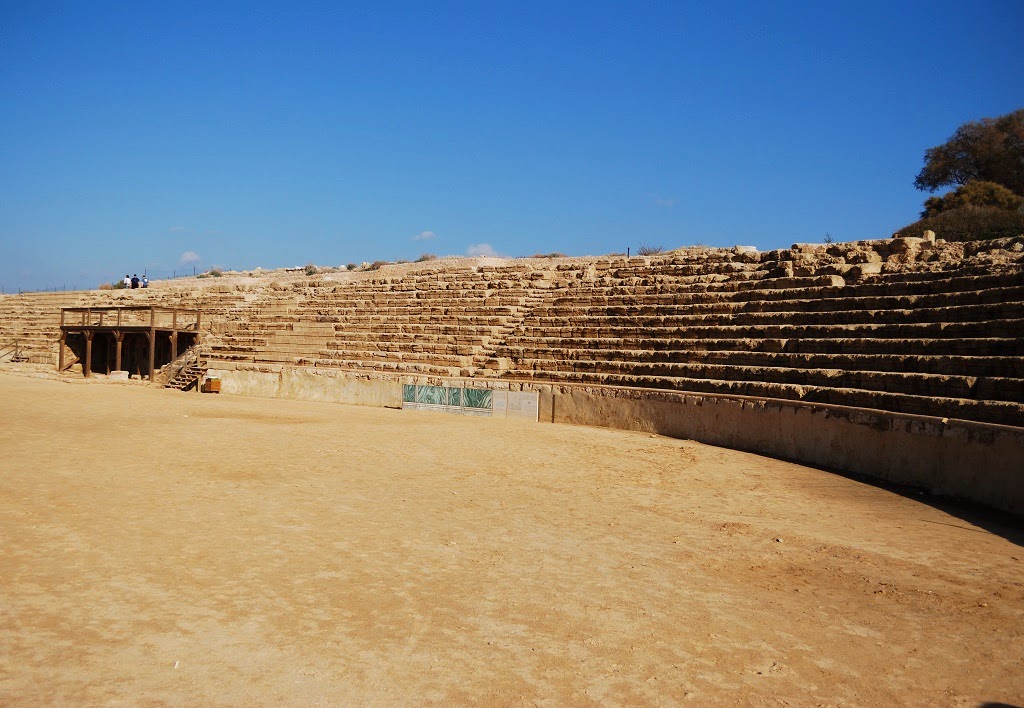
Our destination here was Caesarea where we visited the ancient city built during the time of Herod the Great.  The first part of the city we saw was the theater which now looks out onto the Mediterranean.  The weather was perfect for us:


Caesarea plays an important role in the New Testament because apart from Jerusalem it was the most important Roman city in Judea at the time.  As we sat in the theater I read part of the story in Acts 10-11 where Peter preaches to the household of Cornelius in Caesarea and he becomes the first Gentile baptized into faith in Jesus.  It's one of my favorite stories in the Bible and one I recommend reading if you aren't familiar with it.  As we finished our reading and were about to get up, a group of Koreans took the stage and began to sing.  We immediately recognized it as "How Great Thou Art."  It was a really beautiful moment as our group started to sing along with them and exchanged applause afterward.  Interestingly enough, we'll encounter this same group again the next day in Bethlehem, complete with more singing:


We walked down to the front of the theater so we could see the seats up close.  The lowest seats are original and everything above them has been reconstructed.  Apparently they still hold concerts and events here during the summer months.


Leaving the theater, we entered the area of Pontius Pilate's palace and the hippodrome (chariot racing stadium).  The columns mark where the palace stood on a jetty extending out into the Sea.  This is where Paul was most likely brought when he was under house arrest here in Caesarea for several years, although where he would have been held is just out of frame to the right.  Interestingly, this is the only location where they have found Pilate's name carved in stone.


We thought it looked like a nice place for a group picture:


Then we went down into the hippodrome, passing something that will be familiar to you if you saw my post about Beth She'an.  On the wall to the left are some public toilets.  Through the gate you can see the track of the hippodrome with the sea wall on the left.


Turn 4 at the hippodrome.  Apparently, they've found a slight hill in the track here, meaning this was probably the most exciting place to sit because this is where the most crashes would take place.  I guess some people have always watched just for the crashes.  


We sat for a bit near the hippodrome so I could read part of the passage from Acts where Paul makes his defense before Herod Agrippa and Governor Festus in Caesarea before being sent to Rome.  I made sure to include one of my favorite verses in scripture and my seminary class' unofficial motto: "While (Paul) was making his defense, Festus exclaimed, 'You are out of your mind, Paul!  Too much learning is driving you insane!'"  (Acts 26:24)  After finishing that short devotion time, we walked on toward the north end of the ruins along the sea wall:


Beyond some more of the city, we came to the old port of Caesarea.  This is most likely where Paul was put on the ship to Rome:


Before leaving the ruins at Caesarea, we used the restroom in a place where they have some shops and a cafe.  While waiting there, someone shared the news with us that Ariel Sharon had passed away.  On our way out of the ruins, we walked through another old Crusader fortress that was built here in the 12th century.  Another moat was here, similar to what we saw at Belvoir, although this one was always dry:


Before leaving Caesarea, we stopped at the site of the ancient aqueduct that brought water to the city.  At this location it sits right on the beach, so this was also our chance to dip our toes in the Mediterranean Sea.  A view through one of the aqueduct arches to the Sea:


Looking back toward the bus, we see Pastor Art the Conqueror, this time accompanied by his lovely bride:


A wider view of the aqueduct:


Another "foot shot."  For once, I probably had the most sensible shoes in the group.  After long days of walking on rocky ground and through ancient ruins, the sand felt wonderful!


A picture looking north along the coast with some goofy pastor in the way:


From Caesarea, we headed south along the coast to Tel Aviv, then turned east toward Jerusalem.  I tried to get a few pictures of Tel Aviv as we drove right through the heart of the city.  Unfortunately, the sun was in a difficult place to get much, but this one turned out halfway decent:


I also was able to take my first picture of an Israeli train (if you don't know, I like trains).  Because we were traveling on Saturday, the Sabbath, I was surprised to see anything moving, but this locomotive was going somewhere as we passed the airport (you can see an El Al hangar in the background).  


We arrived in Jerusalem as the sun set.  Our guide took us up to the Mount of Olives to get our first look at the Old City of Jerusalem before we went to our hotel.  It was amazing to stand and look over the Kidron Valley at dusk, anticipating what the next days would bring for us.  


That was it for our fourth day of touring.  It's now past 11:00 PM here, so I need to get some sleep before our big day in the Old City and along the Via Dolorosa tomorrow.  Peace to you all!

+PBK